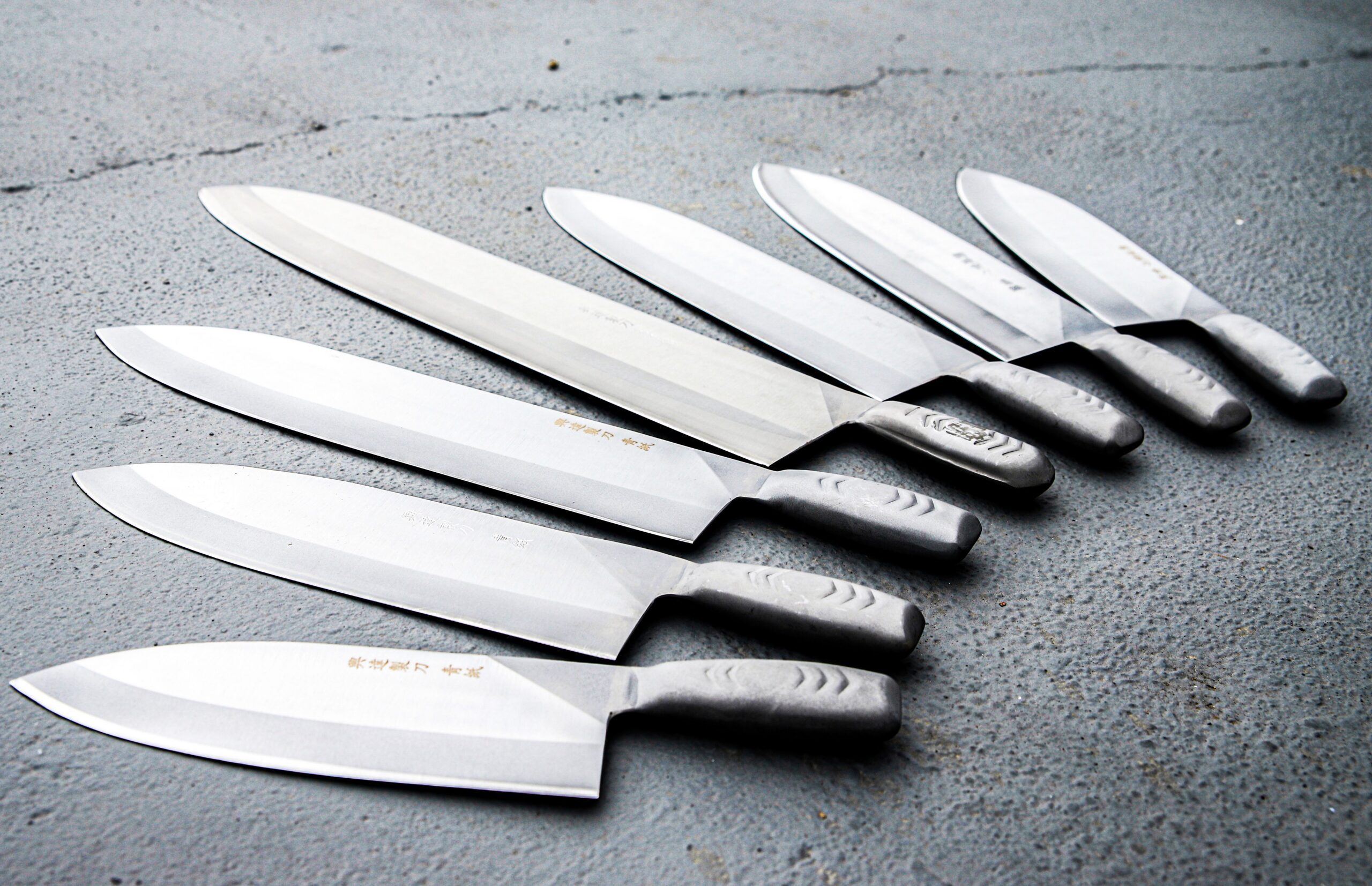
There’s a point in cooking where you realize the knife isn’t just a thing you use to cut food.
It’s part of how you cook.
And if you’ve ever stood at the cutting board hacking your way through an onion while wondering why dinner is taking approximately seventeen years, your knife may be trying to tell you something.
You’re fighting it.
I spent a lot of years in professional kitchens, and I learned pretty quickly that good knife skills aren’t about showing off how fast you can turn an onion into microscopic cubes.
Nobody needs that kind of pressure in their own kitchen.
It’s about making the knife do the work instead of making your hand do all of it.
A sharp knife is your friend. A dull knife is an asshole.
This is probably the most important thing.
A sharp knife cuts.
A dull knife squashes, slips, tears, wanders off in unexpected directions and generally makes you question your life choices.
You don’t need an expensive Japanese knife that costs more than your first car.
You need a knife that feels comfortable in your hand and has an edge that actually works.
And please don’t wait until it won’t cut a tomato without flattening the poor bastard.
A little maintenance goes a long way.
You don’t have to cut like a chef on television.
You know those cooking shows where someone is holding an onion and their knife is moving so fast it sounds like a tiny machine gun?
Yeah.
You don’t need to do that.
Fast knife work comes from small, controlled movements, not from trying to win the Onion Olympics.
Speed is a side effect of confidence.
Get comfortable first.
The speed comes later.
Or it doesn’t.
You’re making dinner, not auditioning for Top Chef.
Your other hand has a job too.
The hand holding the food isn’t just sitting there hoping for the best.
Curl your fingertips slightly so your knuckles are toward the knife.
Your knuckles become the thing the side of the knife touches.
It’s a simple little trick, but it changes everything.
And here’s the part nobody needs to yell at you about:
Pay attention.
Don’t chop while staring at the television.
Don’t reach for your phone while the knife is in motion.
Don’t try to catch a falling knife.
The floor can have it.
Seriously.
Let the knife move.
Here’s something that took me years of kitchen work to stop thinking about consciously:
You generally don’t want to smash the knife straight down through everything.
The blade has an edge for a reason.
For a lot of chopping, you’re making a slight rocking or forward motion with the blade.
Think:
forward and down.
Not:
WHAM.
That little movement lets the blade slice instead of forcing it through the food.
And once you get the feel for it, chopping becomes much less work.
Uniform pieces aren’t about being fancy.
There’s a practical reason chefs care about getting things roughly the same size.
If you’re making soup and you’ve got one carrot the size of a thumbnail and another one the size of a baseball, they’re not going to cook at the same speed.
One gets soft.
One stays stubborn.
Then you’re standing over the pot wondering what the hell happened.
You don’t need every carrot to look like it came out of a factory.
Just aim for roughly the same size.
That’s enough.
Onions are where the knife earns its keep.
An onion looks innocent.
It isn’t.
It’s slippery, round, layered and perfectly designed to make you cry while you’re already annoyed.
Here’s the trick:
Cut the onion in half through the root.
Peel it.
Leave the root end attached while you’re doing your cuts.
That gives the onion something to hold itself together.
Then slice across it and chop through.
And suddenly you’ve got a pile of reasonably respectable diced onion instead of onion confetti scattered across your cutting board.
There’s no prize for making every piece identical.
Unless someone is judging your onions.
In which case, I have questions about your dinner party.
And then there’s the claw.
You’ll hear chefs talk about the “claw.”
It’s basically the way you position the fingers of your food-holding hand so your fingertips are tucked safely away while your knuckles guide the blade.
It sounds ridiculously simple.
Because it is.
But it’s one of those tiny habits that makes cutting feel much more controlled.
And once it becomes automatic, you don’t have to think about it.
That’s really what good knife skills are.
Not tricks.
Habits.
Your knife should make cooking easier.
That’s the whole point.
If you’re gripping the handle so tightly your hand hurts, something isn’t right.
If you’re pressing down like you’re trying to cut through a countertop, something isn’t right.
If you’re taking forever to chop vegetables because every cut feels awkward, something probably isn’t right.
Stop.
Reset.
Put the food somewhere stable.
Get your fingers out of the way.
And let the blade do its job.
You don’t have to become a chef.
You just need to stop making dinner harder than it needs to be.
Because the best knife skills aren’t the ones that look impressive.
They’re the ones that make you stand at the cutting board and think:
Oh. That’s better.
And then you get on with making dinner.